Comparing energy conservation standards in Japan, Germany, and Switzerland ④
Considering the "heating load" required by Japanese standards
Next, I worked backwards from the primary energy used for heating to determine how much "heating load" the Japanese standards require. For Germany and Switzerland, the heating load standards are set from the beginning, so I used those as they are. It may be easier to understand if you think of the heating load as "the total amount of heat required over the heating period when maintaining the room temperature at a constant temperature." The heating load is mainly determined by "insulation," "airtightness," and "solar radiation acquisition," so it doesn't matter what kind of heating equipment you use or what the PEF value is.
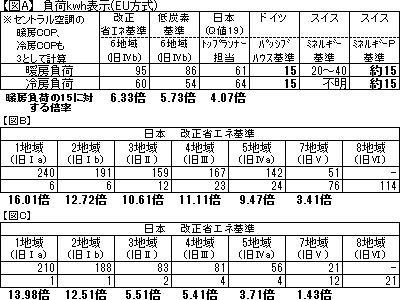
Figure A below compares the heating and cooling loads considered by different countries. What can be seen from this is that when looking at heating load alone, the difference is even greater than when comparing primary energy. Even with the envelope performance of the top runner standard, it is four times worse than the passive house standard, and six times worse under the revised energy conservation standard. This means that four or six times as much energy is required to maintain the same temperature. In fact, when looking at the "Energy Conservation and Health Map for Buildings," which displays the heating loads of Japanese housing manufacturers as well, it can be seen that most major manufacturers keep the heating load at 4 to 4 kWh/m6 (http://tatemono-nenpi.com/map/).
In Figure B below, we also compared the heating and cooling loads of regions other than the six regions. Looking at this, we can see that even within Hokkaido, there is a difference of 6 times in region 1. Region 16 is thought to be colder than the coldest region in Germany. This is why we can expect values like these. For example, the average January temperature in Asahikawa is -1°C, but in Hamburg, in the northernmost part of Germany, it is about 7.5°C. Since the amount of solar radiation is different, it is not an equal comparison, but the 1.5°C corresponds to Fukushima. Fukushima corresponds to four regions, so when comparing regions with similar outside temperatures in January, we can see that there is a difference of 1.5 times.
Here we will also compare the standard values for "partial intermittent heating and cooling" that are considered by those creating the system, as well as most practitioners and clients (Figure C below).
Looking at this, we can see something unexpected. We can see that in warmer regions, partial intermittent heating does indeed result in significantly less energy consumption. However, the difference becomes much smaller in colder regions. This may also be one of the reasons why whole-house heating is the norm in cold regions.
However, it is important to note here that even with partial intermittent heating, the standard values in all regions are significantly higher than the values set by Germany and Switzerland when the entire building is heated. This shows that "even if Japanese people endure the cold and sacrifice their health, they still end up using more energy than German and Swiss homes, where the entire building is warm and cozy." Also, the natural temperature difference (room temperature without heating) assumed in the revised energy conservation standards (next-generation energy conservation levels) is at most about 7°C. Even in Tokyo and Osaka, the temperature drops to around 1°C in the early morning on the coldest day in January. This means that there is a good chance that the room temperature on such mornings will be below 0°C.
What I want to say here is not that "Japan's standards are therefore bad." Rather, Germany and Switzerland believe that "for people to be healthy and comfortable, we must maintain a room temperature of 20 degrees Celsius. However, it is also absolutely necessary to reduce CO2 emissions. Energy prices are definitely on the rise. If we work backwards from our goals to meet these conflicting conditions, the only way is to minimize the heating load."