




High-insulation renovation


The price of new custom-built homes is rising steadily. As a result, many people are unable to buy high-performance homes even if they want to. The solution we would like to propose in this case is "high-insulation renovation." High-insulation renovations are often 500 to 1000 million yen cheaper than a new custom-built home with the same performance, with high insulation and earthquake resistance. We explain in detail the benefits, specific methods, and how to search for properties. We are making the information available free of charge, including much of the information we provide to construction companies that provide technical guidance for a fee. We have created content that we would like not only the general public to see, but also construction companies that are having trouble receiving orders for new homes.
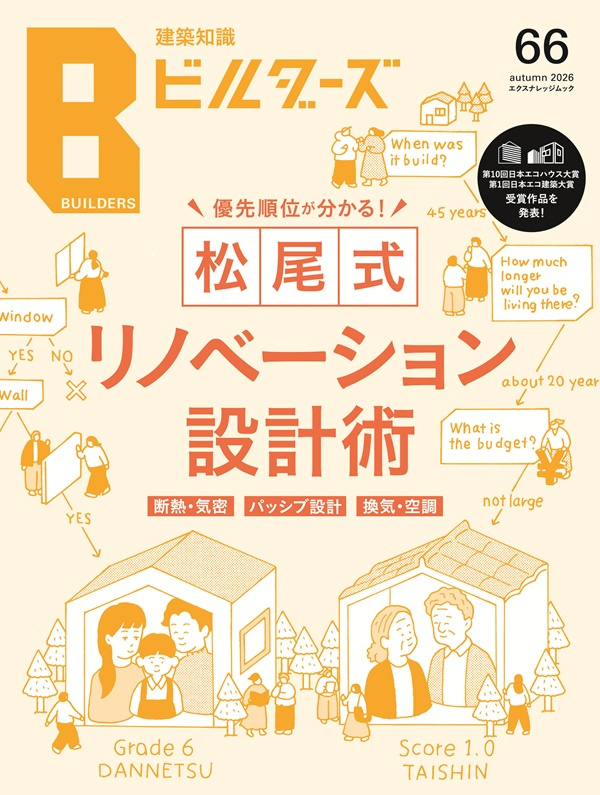
Architectural Knowledge Builders 66: Matsuo-style Renovation Design Techniques
"Architectural Knowledge Builders 66" featured an article on Kazuya Matsuo's "Matsuo-style Renovation Design Techniques."
This book explains what to prioritize and how to allocate costs in renovations, focusing on insulation and airtightness, passive design that utilizes light and heat, and ventilation and air conditioning planning. It also includes examples of renovations of existing homes and traditional Japanese houses. This book is recommended for anyone who wants to make their current home more comfortable.
Click here for the product page. Click here to purchase on Amazon.

Mistakes about energy-efficient homes
This book clearly explains the truth about the "common sense" of environmental considerations regarding energy conservation in housing, which even construction professionals often misunderstand, with concrete figures. With the rise in energy prices, this is a book that both consumers and housing practitioners should know about energy conservation in housing, which is essential for protecting our livelihoods, and will help prevent "housing poverty."
This book is an expanded and revised version of "Eco-Houses That Are Actually Cheap" (Nikkei BP, 2017), incorporating the latest information.

Architectural Knowledge Builders 48: Smart, efficient and high performance! Matsuo-style residential design techniques
The out-of-print special issue of Architectural Knowledge Builders on Matsuo Design Office has now been released in PDF format by Ex-Knowledge.
The book uses illustrations to clearly explain the design techniques using keywords such as passive, insulation, floor plan, durability, equipment, and renovation, and also provides a thorough explanation of how the design techniques are applied to actual homes based on the latest examples from Matsuo Design Office.
In addition, there is a lot of information such as the quality control techniques of Matsuo Design Office, a conversation with Kazutoshi Mizuno, the creator of the GT-R, and an introduction to the construction of houses by construction companies that collaborate with Matsuo Design Office. You can learn everything about Matsuo Design Office in this one book!

Matsuo Design Office YouTube Channel
"Realizing a home that is cool in the summer and warm in the winter with low heating and cooling costs." A home that is extremely resistant to mold and dust mites. A home with a quiet and ideal indoor environment. We will reveal the know-how to maintain a sturdy home for more than 100 years after construction with minimal maintenance costs, even in this era of 50-year life expectancies.
I would like this film to be viewed not only by the general public, but also by practitioners who have never properly studied thermal environment, structure, and durability.
For custom homes in Nishinomiya City, choose Matsuo Design Office
Our company is a design firm based in Nishinomiya City that builds high-performance custom homes that are cool in the summer and warm in the winter.
Highly airtight and insulated homes that keep the entire house comfortable with just one or two air conditioners, energy-saving designs that utilize solar radiation gain in winter and solar shading in summer through sun-friendly design, and structural calculations for earthquake resistance level 3 for all buildings. We use genuine materials that grow more beautiful with age and general-purpose equipment that reduces replacement costs, allowing clients to use most of their precious budget for the home itself. We value the careful construction of homes that are tailored to each individual, which is possible only with a small but elite team.

MS DG Single-story building
We have released a small single-story standard housing MSDG!
Prices start from 2100 million yen (excluding tax). *Exterior construction, furniture, etc. are separate. This is just a reference price, as the construction cost varies depending on the region and construction company. The total floor area is small at 20 square meters, but it is suitable for two people in their old age, or for a family of three with one child. The attic is an air-conditioned room, but it is also 3 square meters in size, so it can store a large amount of boxes and seasonal items. By installing a large window on the south side and minimizing the east, west, and north sides, the house is quite warm and cool even before relying on air conditioning.
[MSDG single-story standard specifications]
・Attic air conditioner cooling ・Underfloor air conditioner heating ・Solar power generation 4kW ・Ohisama Ecocute
・Resin sash triple glass ・C value below 1 ・Seismic resistance grade 2 ・HEAT GXNUMX
NEWS
News
-
We have released YouTube video 30: [Nishinomiya City] Connecting Gardens and Work [Matsuo Design Office]
-
On Saturday, October 31st, we will only be able to offer this service for a limited number of groups between 10:00 AM and 4:00 PM, and only during the time slots for which reservations have been made.
-
We have released YouTube video #29: [Nishinomiya City] Custom-built house that takes advantage of the view [Matsuo Design Office]
EVENT / BLOG
Event Information / Blog

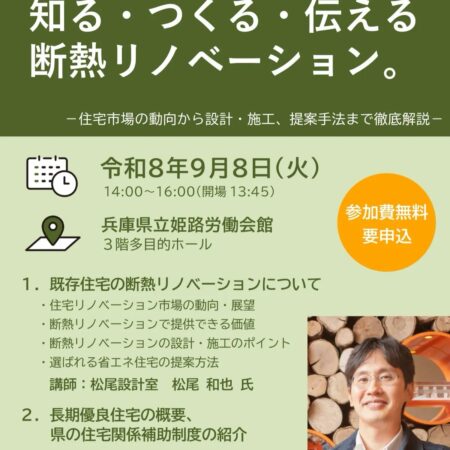
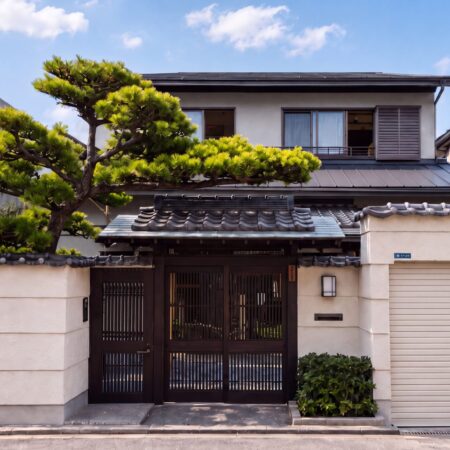
GUIDE LINE
High-performance housing guidelines

List of recommended housing companies by prefecture

Allowable stress calculation and seismic resistance grade 3

Attic air conditioning cooling and underfloor air conditioning heating

Even the professionals get the "misconceptions" and "questions" about high-performance homes wrong

Checklist for selecting a housing company
Click to enlarge. Housing Company Selection Checklist – Minimum Requirements Earthquake Resistance Grade 3 The first question to ask to determine whether a housing company is legitimate is "...
The origins of Matsuo Design Office
"To economically realize healthy, comfortable, and energy-efficient homes" is the motto of Matsuo Design Office. The reason for this motto dates back to my (representative Matsuo's) formative experience in 1991, when I was a first-year high school student. Until then, I had lived in a five-story reinforced concrete public housing complex. It was a simple dwelling that was by no means affluent, so I remember being very happy when I moved into a newly built detached house constructed by a major housing manufacturer. The size of the house increased by about 2.5 times, and the appearance and facilities were vastly improved.
However, the new house was much colder in the winter and unbearably hot in the summer than the prefectural housing I had been living in. My joy at moving was short-lived, and even though I was still a high school student, I had serious doubts about whether this was really a rich life.
At that time, I saw a front page advertisement in the newspaper for a house that collects heat on the roof and releases it under the floor. I thought, "This is it!" That was the trigger for me to go to the architecture department at university, and within that, I chose a laboratory for thermal environment engineering. The theme of my graduation thesis was "Research on air-heated houses with floor heating." Since then, I have been dedicated to residential design.


Use only things you can continue to use
My parents' house is now almost 30 years old. It was built right around the time of the Bubble Era, so it had all kinds of special equipment. A central cleaner, an intercom in the house, a whirlpool bath, an electronic lock, a cassette air conditioner on the ceiling, and so on. However, the appliances in the house started to break down one after another after about five years. I would try to get estimates each time, but the equipment was out of stock. Or it was too expensive and it was cheaper to buy it at a home appliance store. Or I've seen most of the equipment last for only one generation because "it's not a problem without it."
From this experience, we learned the lesson that "while we should allocate a substantial budget to things that cannot be easily replaced, such as insulation, we should use readily available, replaceable parts for equipment whenever possible."
I took over from my father in 2003 and since then we have worked on over 200 highly insulated and airtight homes and facilities, as well as renovating them. With the exception of a few special cases, 99% of our design work has been highly insulated and airtight.
Underfloor air conditioning for heating and attic air conditioning for cooling
In 2010, we established the first underfloor air conditioning heating system in Japan using floor-standing air conditioners, and this was featured in the April 2012 issue of Kenchiku Chishiki (Architectural Knowledge). (External link) Currently, all construction companies throughout Japan that use floor-standing underfloor air conditioning heating systems have started their projects based on this book.
In 2011, we established the "attic air conditioner cooling" method, which involves installing an air conditioner in the attic to cool the house. Initially, when the attic air conditioner was not cool enough, we would cool the entire house by using the cooling function of a floor-standing air conditioner placed for heating on the first floor in addition, but since 1, we have established technology that allows us to cool the entire house using only the attic air conditioner.
Currently, whole-house air conditioning is booming in the housing industry, and I know of over 30 different whole-house air conditioning systems. However, all of them cost over 150 million yen for homeowners, so most companies can only offer them as an option. It's pointless if you can't live a healthy and comfortable life without money . With our underfloor heating and attic cooling air conditioning systems, you can achieve whole-house air conditioning for around 40 yen.


Improve your technical skills to reduce total costs
Our method makes the whole house warm or cool for the cost of installing one or two air conditioners. It is a very simple system that uses only a regular air conditioner sold at a mass retailer and has almost no ducts. However, because it is a simple system, it requires many subtle design tips.
Over the past 10 years, we have adopted the attic air conditioning system in over 100 houses, and have established a reproducible design method through repeated calculations, failures, and corrections. Currently, there are many construction companies across the country who want to learn this method, and we have provided guidance to a total of several dozen companies. Underfloor air conditioning for heating rarely fails, but attic air conditioning for cooling has a high probability of failure, such as "not working" or "condensation," if designed carelessly without technical skill and calculations.
We aim to create a home that is warm and cool throughout, meets seismic resistance level 3, and is durable enough to last for over 30 years while keeping total costs down. This vision is encapsulated in the single phrase , "Economically realizing healthy, comfortable, and energy-efficient homes." If you are interested, please start by reading " How to Choose a Housing Company and Why You Might Be Confused ."
Matsuo Design Office aims to achieve a 2030% ZEH (Zero Energy House) rate by fiscal year 100.
(SII ZEH Builder/Planner List Search)
| 2016 | 2017 | 2018 | 2019 | 2020 | 2021 | 2022 | 2023 | 2024 | 2025 | 2026 |
|---|---|---|---|---|---|---|---|---|---|---|
| 25 % | 59 % | 50 % | 50 % | 53 % | 56 % | 42 % | 70 % | 60 % | 70 % | 100 % |
Matsuo Design Office will promote the conversion of non-residential buildings (under 10,000 m², all uses) into ZEB (Zero Energy Buildings) by fiscal year 2030.
The goals are to achieve a "ZEB penetration rate of 50% or more" for new construction and a "performance growth rate of 50% or more (compared to the 2025 fiscal year)" for existing buildings.
We will work to promote the widespread adoption of ZEB (Zero Energy Building) from both design and consulting perspectives.
– ZEB Order Ratio for FY2025 –
| Small scale (less than 300 m²) | Medium-sized (300 to less than 2,000 m²) | Large scale (less than 2,000 to 10,000 m²) |
|---|---|---|
| 0% | 0% | 0% |
Leveraging the technology we have cultivated through high-insulation and high-performance design, we will actively promote ZEB (Zero Energy Building) proposals going forward.